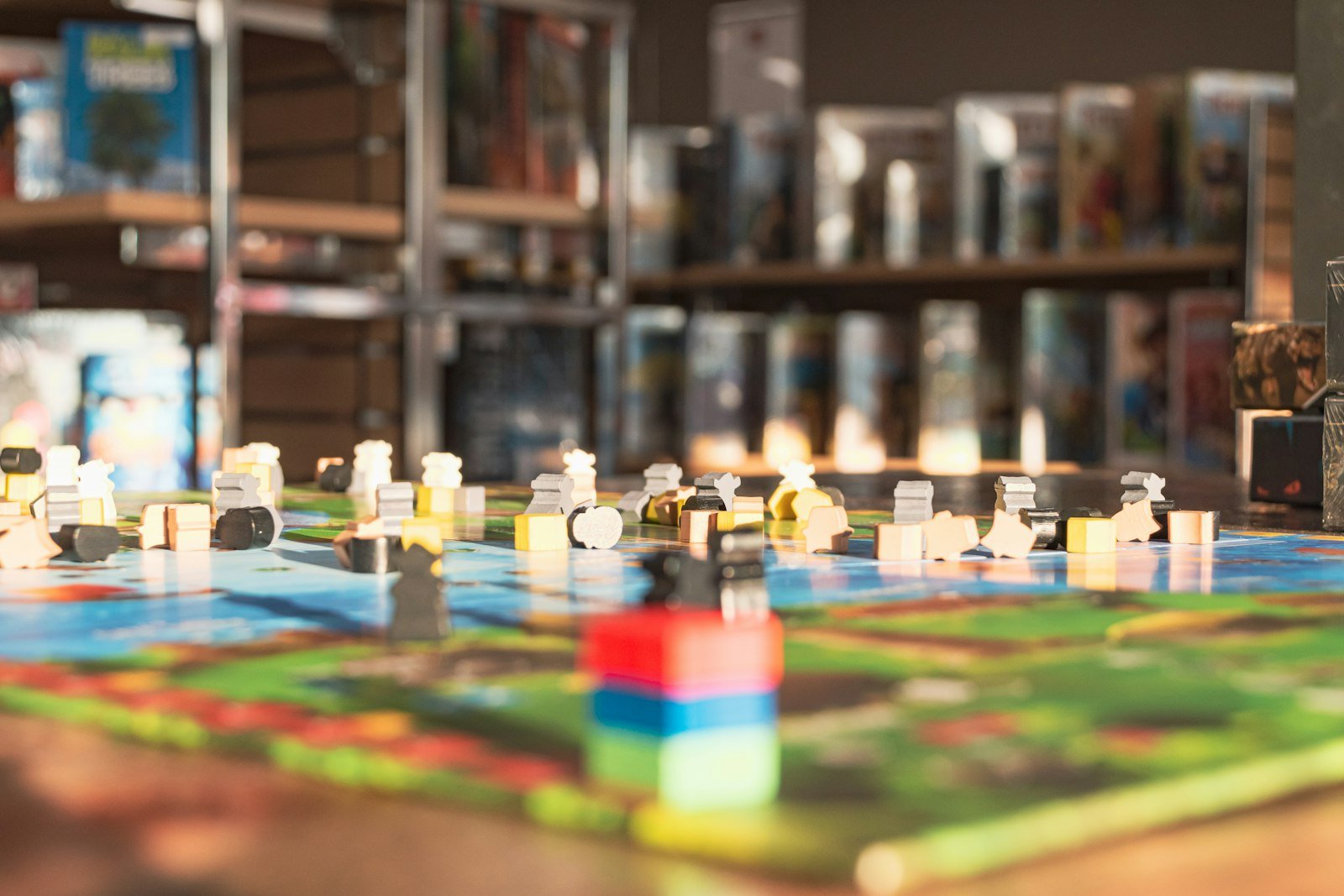

Pocket Orbit started as a dare. Tomas said a deck-builder needed at least a hundred cards. Rūta said she could draw eighteen. The game is the argument, settled.
You are a tiny spacecraft trying to climb from a low orbit to a high one before your fuel and your patience run out. Every player starts with the same six cards and shares a market of twelve more. That is the whole game: eighteen cards, a handful of tokens, a scoring strip. You build your deck by nudging cards out of the shared market, which means buying a card is also taking it away from everybody else, and the market never refills.
How it plays
On your turn you play your hand, count thrust, climb that many orbits and buy at most one card. The twist is the burn: any card you buy is removed from the game at the end of your next orbit unless you have kept a fuel token for it. So your deck never gets bigger than nine cards, and it is always changing. Games are about twenty-five minutes at four. The solo mode races a dummy spacecraft with its own tiny deck and no mercy.
Mechanics: deck-building, a shared dwindling market, hand management, a race track. Two to five players, or one. It plays best at three, like most things we make.
State of the game
Thirty play-tests exactly, which is our rule, and then four more because we did not believe it. The card art is finished and the print-and-play files are nearly ready; there is a dev-log post on that coming shortly. Because the whole game is a few sheets of paper, Pocket Orbit will be the first thing of ours you can print at home. Physical copies with proper linen-finish cards will follow at conventions and local shops once the files have been out for a while.